
Browse Items (771 total)
Sort by:
-

Becoming Visible: First Black Lesbian Conference
Front and Back View of Brochure -

Barbara Smith Classroom Discussion (Tape 7)
Recorded classroom discussion focusing on a fictional story about lesbians and the erotic. Continuation of #6. Location uncertain. -

Barbara Smith Classroom Discussion (Tape 6)
Recorded classroom discussion focusing on a fictional story about lesbians and the erotic. Continuation of #5. Location uncertain. -

Barbara Smith Classroom Discussion (Tape 5)
Recorded classroom discussion focusing on a fictional story about lesbians and the erotic. Location uncertain. -

Barbara Sang Interview, April 22, 1989
Barbara Sang is interveiwed in 1989. She talks about how she went through psychotherapy and attempted to live as a heterosexual woman. She discusses her role in the New York chapter of DOB as the Education Chair and the programs and events she organized as well as finding as much information as she could about gays and lesbians. She also talks about DOB in the 1960s and the privacy it afforded its members, not insisting that they come out, which was criticized by more radical movements. -

Barbara Gittings and Kay Tobin Interview, 1988
Barbara Gittings talks about her life and her history with the Daughters of Bilitis. She served as the National Corresponding Secretary for DOB and helped run the NYC chapter when she was living in Philadelphia. Despite that, she frequently criticizes DOB positions and found herself to be more radical in her approach to activism. She speaks about concerns of being infiltrated by the FBI, and heists of the publication "The Ladder". The interview closes with Gittings speaking about organizing for conferences and workshops, including creating exhibits for the 1971 American Psychiatry Conference in San Francisco. -

Barbara Emmerth Interview, February 21, 1988
Barbara Emmerth is interviewed in New York City in 1988. She discusses the uniqueness of coming out on West Virginia in the 1950s where there was little stigma attached to homosexuality because there was so little understanding or awareness of it. She speaks about her relationships, moving to New York City in the 1960s and her involvement with DOB (including a brief stint as the VP of the New York chapter) and with SAGE (Services & Advocacy for Gay, Lesbian, Bisexual & Transgender Elders). -
-

Back Alley Theatre
Elaine Heffernan (director) and Jo Meyer (lighting design) are interviewed about their work with Back Alley Theatre on "The Independent Female, or A Man Has His Pride" and "Eve Has Not Been in Paradise Yet." They discuss the state of theater in relation to feminism, politics, and social consciousness.
Note: Some parts of this tape suffer from water damage and are difficult to hear. -
![[2014SP]Bachelorettes_SIde_B.mp3](/omeka/application/views/scripts/images/fallback-audio.png "[2014SP]Bachelorettes_SIde_B.mp3")
Bachelorettes, Side B, September 5, 1981
The sound recording is women singing the old hymn "Down in the River" with the words changed slightly. The rest of the recording is the women singing various songs. -

Audition Tape
Collected Auditions for Radio Free Women: Interview with Robin Morgan, Interview and poetry readings with [???] and Rita May Brown, discussion of D.C. rape hearings with selected poets from Washington D.C. Rape Crisis center, Excerpt from 1972 Radio Free Women Collage show "Waitresses". Excerpt from 1973 Collage show "Advertising"
Audio fades out and in at several points. -

At the Museum of Natural History
Lesbians dancing, Martha Shelley on the right. -

Astraea Foundation Letter to Donors
A letter sent to individuals who have previously donated to Astraea, requesting renewed support. -

Astraea Benefit, "Conversation with Poems," 1981 (Tape 2 of 2)
Benefit for the Astraea Foundation, "Conversation with Poems." Poetry reading and conversation with Audre Lorde and Adrienne Rich; includes speech, poetry, and remarks. -

Astraea Benefit, "Conversation with Poems," 1981 (Tape 1 of 2)
Benefit for the Astraea Foundation, "Conversation with Poems." Introduced by unnamed speaker. Poetry reading and conversation with Audre Lorde and Adrienne Rich; includes speech, poetry, and remarks. -

Astraea
Short clips of several interviews with various members of the Daughters of Bilitis about their experiences with the group and being a lesbian in the 1950s and thereafter. -
-

Arcus Flynn Interview, November 1, 1987
Arcus Flynn discusses her early life and her struggle with isolation and depression, her eventual discovery of the Daughters of Bilitis meetings and the community and friendships she found there. Arcus talks about the early importance of roles assumed by lesbians in the community (butch/femme), her involvement with the Women’s Rights movement, her evolution from Catholicism to born-again pagan spirituality (the Irish triad: truth, knowledge, and nature), and her discovery of herbology and natural healing. -

Anti-Lesbian Violence
This is a recording of assorted clippings regarding women's safety.
Note: No Audio.Tags Police harassment -

Annie, July 10, 1985 (Tape 1)
A woman talks about her time married to a man as compared to her time in a relationship with a woman, and the pros and cons of both. -

Anne MacKay Interview, April 24, 1988
Anne MacKay is interviewed in Orient Point, New York in 1988. She discusses the early days of the DOB, lesbian conventions, coming out to her family, socializing, theatrical productions to help fund the Lesbian Herstory Archives, and relationships between lesbians. -

Ann II, October 23, 1980 (Tape 2)
Ann describes what she looked for in a women. Discusses the clothing change among lesbian women. Explains some of her relationship experience with women. -
Ann Biderman Interview
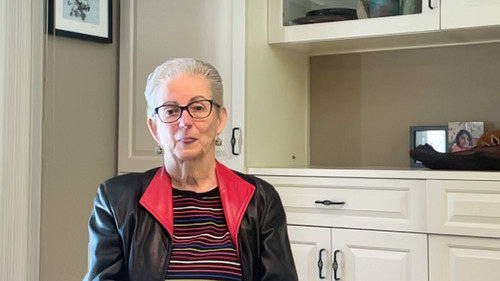
In this oral history conducted by the Rossmoor Lesbian Social Club, Ann Biderman discusses her early feelings for other girls, her coming out process and mixed reactions that led her to be fearful of coming out to people. She talks about her relationship with her parents, looking for a Jewish Lesbian community in Austin, TX and eventually moving to San Francisco in 1987. Ann discusses her involvement with Bay Area Career Women, her Temple, and the National Center for Lesbian Rights. -

Anita, undated (Tape 2)
Anita talks about being in an interracial relationship with a white woman, and the roles of butch and femme. -

Anita, November 16, 1978 (Tape 1)
Anita talks about her first encounters with a relationship with a woman. She then speaks about the difficulties of raising her child. She also talks about the roles of Butch and Femme. -

Andy, March 30, 1982 (Tape 1)
Andy discusses the history of gay rights in Buffalo, New York, and describes how it feels like to be open about her sexual identity. She shares some of her childhood and early adulthood experiences in the 1950s and 60s –her first relationships and confronting the risk of losing her job. Other topics discussed include the gay and lesbian bar scene, raids, prostitution, butch and femme roles, and Andy’s experience within the African American gay community. -

Andy, April 28, 1982 (Tape 4)
At the start of the interview, Andy talks about the first time someone asked her about sex. She talks about her experience going with hookers. She discusses butches and femmes and argues that femmes aren't "true" lesbians. -

Andy, April 20, 1982 (Tape 2)
Andy further discusses how she came to construct her butch image. She recalls getting into fights with men and having to give up good jobs because she refused to give up her queer image and identity. She discusses her clash with a teacher when she was in school in the 1950s. She describes her relationship with a prostitute and other close relationships. On side B she talks about breaking into the butch scene and coming out. Andy talks about gay bars and places queer women were welcome or not. She discusses fashion and explains why they wore their t-shirts backward. -
Andrea Gourdine Interview
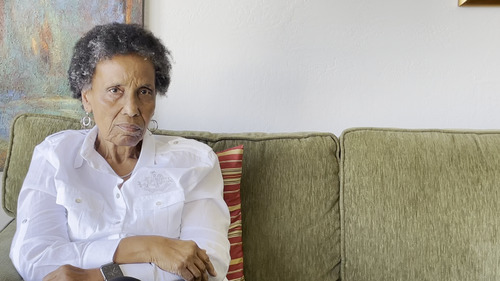
In this oral history conducted by the Rossmoor Lesbian Social Club, Andrea Gourdine discusses growing up conservative in the bay area and the racial discrimination and segregation she and her family faced in 1940s in Richmond, CA. Her coming out process and the response from her mother. She discusses her career in HR which lead her to be the first black woman working in HR for the City and County of San Francisco where she ultimately become the director and the closeted environment of her professional work. She touches on her experience with the lesbian community in San Francisco and finding herself through that community, and later, through the Rossmoor community. -
Andrea Gilbert Interview
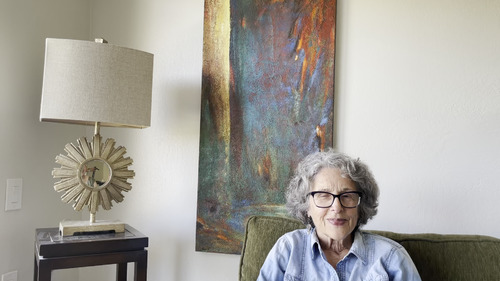
In this oral history conducted by the Rossmoor Lesbian Social Club, Andrea Gilbert discusses her coming out process later in life and in relationship to her marriage to a man, her divorce, and her relationship to her children; as well as her family’s reaction to her coming out as a lesbian. She also discusses the impact of living at Rossmoor and the Rossmoor community on her life and her work in advocacy for the families of LGBTQ people. -

An Evening with Del Martin and Phyllis Lyon
Del Martin and Phyllis Lyon speak at a program for a lesbian movement exhibit. They give an overview of the beginning of the lesbian movement and the DOB's history, including public protests and conventions. They speak about a need for lesbians to be recognized more and to be more visible in the media. Unrelated video clips start after 01:30:42. -
Amy Klitsner Interview
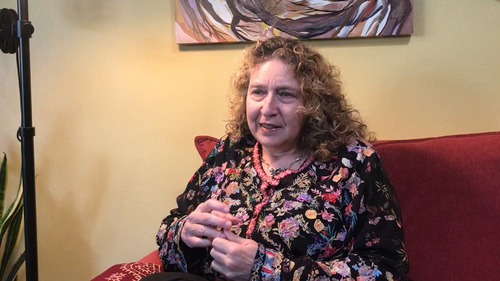
In this oral history conducted by the Rossmoor Lesbian Social Club, Amy Klitsner discuss her family, early life, her realization that she was a lesbian, her coming out process, and finding community with other women and lesbians. -

-

Amazon Country 9/19/76 - Dyketactics
(Side A) Victoria Brownworth opens this episode of Amazon Country by announcing that an Amazon Country employee lost her house, belongings and pets to a fire, so they're starting a collection for her through the Women's Cultural Trust. Various other announcements regard upcoming events, a lesbian support group, and the council elections at the Gay Community Center.
Roberta Hacker interviews Linda Norwood and Sherrie Cohen of 'Dyketactics!' to discuss their lawsuit against the police, the first time in history that lesbians have sued the police for brutality, excessive force, and harrassment. This lawsuit regards police action on December 4, 1975, when 'Dyketactics!' (and other groups) attended a (Philadelphia) city council meeting to help urge passing of the "Gay Rights Bill" by the committee. Philadelphia's Civil Defense Squad immediately approached and used excessive force against the women, prompting 'Dyketactics!' to file a lawsuit against the City of Philadelphia for lesbophobic police brutality. Linda and Sherrie encourage women to attend the trial in order to support them. They also ask for feedback so that they can better represent and stand up for the lesbian community. When Victoria asks what they hope to get out of the trial, 'Dyketactics!' dsecribes their hopes to raise consciousness around the need for gay rights.
(Side B) Linda and Sherrie discuss the positive reception they've had regarding the trial, and announce that there will be a community meeting hosted by 'Dyketactics!' to discuss the disbursement of the (potential) compensation from the lawsuit into the lesbian community. -

Amazon Country - Victoria Brownworth Speaks with Bertha Harris
Victoria Brownworth interviews author Bertha Harris in an episode of Amazon Country. Bertha discusses how writing has been a means of freedom and escape for her, and how she would like fiction to help define what it means to be a lesbian. They also explore whether and how the patriarchy has an impact on what women write. They ruminate on the overlap between politics and art. -

Amazon Country - Gay Community Center
(Side A) Victoria Brownworth this episode of Amazon Country with announcements regarding lesbian and feminist groups and organizations. Roberta Hacker interviews Arleen Olshan of the Gay Community Center. Arleen notes that lesbians are underrepresented in decision-making, policy development and program coordination, and the GCC would benefit from more lesbian involvement. They discuss lesbian separatism (especially relating to how few women are involved with the GCC). Arleen announces upcoming events at the GCC including various lectures by authors and activists, as well as consciousness-raising groups and educational classes. (Continues onto side B) Arleen encourages lesbians to check out the center because they "might be surprised" by the level of feminism that exists within the gay male community.
Includes an ad for the Bicentennial Women's Center. -

Amazon Autumn Event, 1986
Footage of an event held in 1986. Both Deborah Edel and Judith Schwarz are featured sitting at a table for the Lesbian Herstory Archives and are handing out information about lesbian herstory in general and the archives more specifically. Joan Nestle and Mabel Hampton are also featured. -

Alma Routsong Interview, January 20, 1990
Alma Routsong is interviewed in New York in 1990. She discusses her early experiences of being a lesbian and coming out. She explains how lesbian literature of the time informed her about DOB and influenced her to leave her husband and move to New York with her lover. Alma also discusses her writing career and use of a pseudonym. In tape 2 she discusses DOB groups and events, as well as the demise of DOB. -

-

Alix Dobkin Performance [Fair Use Excerpt]
Alix Dobkin sings a collection of her songs at an unknown location. The uploaded file has been cropped due to Fair Use restrictions. Full file available to view at Lesbian Herstory Archives. -

AIDS Clinical Trials Group, 1992
Women from ACT UP LA and some gay men who worked with them, attending the AIDS Clinical Trials Groups Meetings in Washington, D.C. -

Advertisements
Opens with "Reasons" by Minnie Riperton and goes into an advertisement for Sophie's Parlor. A version of the advertisement repeats but is a blooper/is incomplete. Following this, another version of the advertisement plays. Includes sped-up song and an unknown ad, as well as "Check Out Your Mind" by Chaxayn. -

ACTG Meetings with Sten Vermund (Tape 2)
Meeting between ACTG [AIDS Clinical Trials Group] and Sten Vermund discussing Women with HIV/AIDS and the clinical trials and drug testing, as well as treatment options and the future of their work. -

ACT UP Organizing Meeting
Women in an ACT UP organizing meeting strategize how to recruit activists to grow their community and perform inclusive outreach to support different needs, specifically with connecting healthcare professionals with subjects. -

ACT UP and NIAID Meeting on Women and HIV/AIDS
Director of NIAID, Tony Fauci, listens to a presentation by ACT UP activists from New York and Washington, D.C. about the neglect of research for women's health issues in contrast to men's, plus statistics about women with AIDS. -

ACT UP and NIAID Meeting About Natural History Study of Women With HIV (Tape 3)
Meeting between NIAID employee Diane Hartnell and ACT UP, Women with HIV/AIDS, and AIDS activists in Bethesda, Maryland about AIDS research. Side B includes discussions about first women's natural history study with other NIAID employees.Tags AIDS, AIDS Clinical Trials Group (ACTG), Clinical trials, Communities, Consciousness raising, Diane Hartnell, Drugs, Education, Epidemiology, Health care, Illness, Marina Alvarez, Mary Lucy, Maxine Wolfe, Meetings, National Institute of Allergy and Infectious Diseases (NIAID), Seh Welch, Social work, Women's health -

ACT UP and NIAID Meeting About Natural History Study of Women with HIV (Tape 2)
Meeting between NIAID employee Diane Hartnell and ACT UP, Women with HIV/AIDS, and AIDS activists in Bethesda, Maryland regarding research, including the ACTG, women's natural history, sexual health, pregnancy, and questionnaires.Tags AIDS, AIDS Clinical Trials Group (ACTG), Clinical trials, Communities, Consciousness raising, Drugs, Education, Epidemiology, Health care, Illness, Marina Alvarez, Mary Lucy, Maxine Wolfe, Meetings, National Institute of Allergy and Infectious Diseases (NIAID), Seh Welch, Social work, Women's health -

ACT UP and NIAI Meeting About Natural History Study of Women with HIV (Tape 1)
Meeting between NIAID employee Diane Hartnell and ACT UP, Women with HIV/AIDS, and AIDS activists in Bethesda, Maryland regarding the inclusion and diversity of women in AIDS studies, sexual health, ACTG, and pediatric care.Tags AIDS, AIDS Clinical Trials Group (ACTG), Clinical trials, Communities, Consciousness raising, Diane Hartnell, Drugs, Education, Epidemiology, Health care, Illness, Mary Lucy, Maxine Wolfe, Meetings, National Institute of Allergy and Infectious Diseases (NIAID), Seh Welch, Social work, Women's health -

ACT UP and CDC Meeting About Changing the Definition of AIDS (Tape 2)
Meeting at the CDC in Atlanta, Georgia between representatives of ACT UP and CDC Officials about changing the Centers for Disease Control's definition of AIDS to include infections that women and injection drug users were getting. -

ACT UP and CDC Meeting About Changing the Definition of AIDS (Tape 1)
Meeting at the CDC in Atlanta, Georgia between representatives of ACT UP and CDC Officials about changing the Centers for Disease Control's definition of AIDS to include infections that women and injection drug users were getting. -

Abortion
In this episode of Radio Free Women, three members of the National Organization for Women (NOW), discuss the state of abortion after the passage of Roe v. Wade. Mary Bailey (coordinator of the NOW Abortion Coalition), Mary Helen Bloom (member of the national area chapter of NOW), and Mary Garrison (President of the Montgomery NOW chapter) discuss threats to the landmark ruling. They also discuss how women are excluded for the conversation around abortion, as well as where states have the right to regulate and balance issues of state interests with consideration of women's health. -

A: Where Would I Be Without You The Poetry of Pat Parker + Judy Grahn - Pat Parker;
B: Where Would I Be Without You The Poetry of Pat Parker + Judy Grahn - Judy GrahnA collection of poetry performed by Pat Parker and Judy Grahn. Pat Parker's performance speaks of topics such as her Black lesbian feminist experiences, domestic violence, reproductive rights, civil rights, and anti-racism. Judy Grahn's performance talks about her experiences as a lesbian, love, and feminism. -

A: Simone DeBeauvoir
Recorded in Paris with Studs Terkel, Simone de Beauvoir describes her philosophies of life and writing her memoirs, discussing: her childhood upbringing in Catholic school, dynamics with her parents, artistic influences in her life, the experience of being a woman writer, and wartime. -
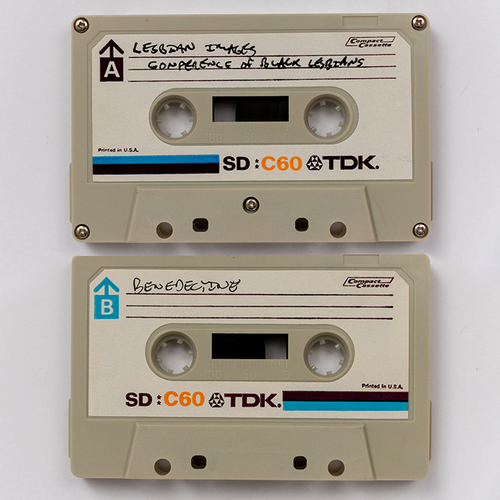
A: Lesbian Images Conference of Black Lesbians;
B: BenedictineSide A: Inaugural broadcast of Lesbian Images, inscribed with the same title on cassette side A, and hosted by Diane and Sonia (last names not noted). The hosts interview organizer Lavinia Penson to promote the Conference of Black Women, which was the first conference gathering Black Lesbians on the East Coast following the historic Conference of Black Women in San Francisco. The hosts took several calls during this program, and a few of the callers expressed racist and lesbophobic views. This broadcast also includes: discussions of hopes for the show; announcements for local weekly meetings and programming for lesbians and women in NYC; a new issue of woman’s prison newsletter “No More Cages”; and promotion for the rally in honor of Dr. Martin Luther King Jr’s birthday and effort to make it a national holiday, as well as an anti-KKK rally in Buffalo.
Also captured at the beginning of Cassette side A, Directly before this broadcast of Lesbian Images, is a short radio play written and directed by Judy Pasternak for "Snapshots: Vignettes of Lesbian LIfe" about a lesbian woman being woken up early to feed her cat. Joan Goldman plays The Woman, technical production by Viv Sutherland.
Side B: Broadcast of Common Ground featuring Mother Jone's editor Adam Hochschild interviewing Carolyn Marshall about her research on drug "Benedictine," an anti-nausea medication prescribed commonly to pregnant women, that may have concerning side effects. -
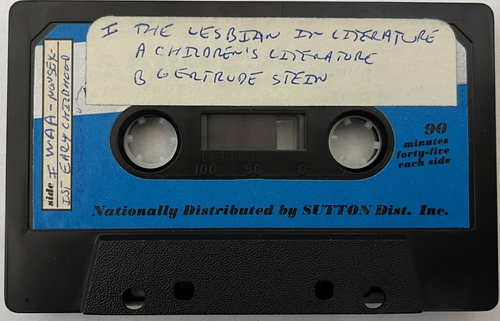
A: I The Lesbian in Literature A - Children's Literature B - Gertrude Stein / I WAA - NONSEX - 1st Early Childhood Curriculum;
B: II Gertrude Stein (Cont.)Recorded at the 1974 Gay Academic Union Conference at NYU, this panel, The Lesbian in Literature, features Janet Cooper and Cynthia Secor, chaired by Virginia Apuzzo. Cooper critiques the erasure of female affection, emotion, and intimacy in children’s literature, tracing it to the influence of early 20th-century librarian Anne Carroll Moore and her control over publishing standards that suppressed depictions of female relationships. Secor’s paper analyzes Gertrude Stein’s feminist and lesbian aesthetics, comparing her to James Joyce while celebrating Stein’s rejection of patriarchal literary traditions and her creation of new forms of expression rooted in female consciousness, identity, and language. Together, the talks explore censorship, literary history, and lesbian representation within both children’s and modernist literature. -
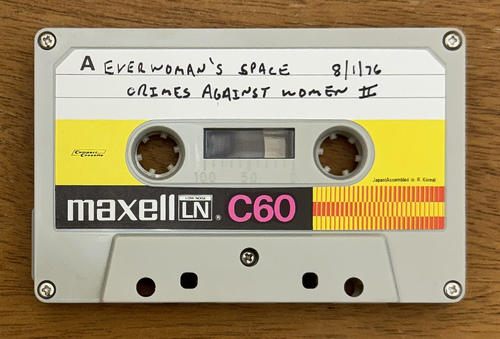
A: Everwoman's Space 8/1/76 - Crimes Against Women II;
B: Everywoman's Space 8/1/76 Violence Against Women IIThis Everywomanspace episode hosted by Irene Yarrow with guests Margaret Robinson, Yolanda Bacow, and Magna Taliswoman, focusing on violence against women. The program highlights rising rape statistics, community actions like the Women’s Walk Against Rape, and the case of Cheryl Todd and Desi Woods, two Black women punished for defending themselves. Discussion expands to systemic injustices, racism, and the importance of women’s solidarity and self-defense. -
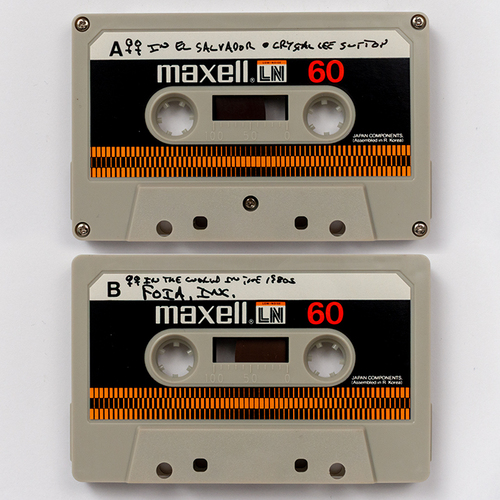
A: ♀♀ in El Salvador - Crystal Lee Sutton;
B: ♀♀ in the World in the 1980s - FOIA, Inc.Side A: Broadcast of radio show, program unknown, with cassette inscribed title “♀♀ in El Salvador - Crystal Lee Sutton”. Recording of live broadcast from a United Auto Workers (UAW) sponsored 1981 International Women’s Day event in Newark, NJ, where union activists Crystal Lee Sutton and Kathy Andrade spoke. Side B: Inaugural broadcast of Women in the World in the 1980s, inscribed title on the cassette "♀♀ in the World in the 1980s - FOIA, Inc". In this program, host Blanche Cook interviews Dr. Ann Mari Buitrago, (author: Are You Now or Have You Ever Been in the FBI Files?: How to secure and interpret your FBI files) and Kathy Engle (poet, organizer) about government efforts to destabilize progressive movements. Buitrago and Engle were the legislative director and executive director of the Fund for Open Information and Accountability Inc (FOIA) at the time of recording. -
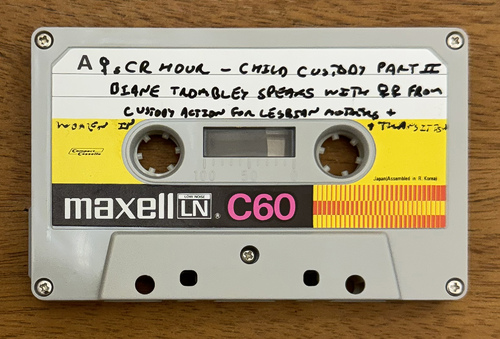
A: ♀'s (Women's) CR Hour - Child Custody Part II - Diane Trombley Speaks with ♀♀ (Women) from Custody Action for Lesbian Mothers + Transition;
B: ♀♀ (Women) CR Hour - Custody Part II - Diane Trombley Speaks with ♀♀ (Women) from CALM + ♀♀ (Women) in TransitionThis episode of The Women’s Consciousness Raising Hour, hosted by Diane Trombley, features an in-depth discussion on the struggles faced by women, particularly divorced and lesbian mothers, within the American custody and legal systems. Guests Jennifer Fleming of Women in Transition and Mickey Weinstein of Custody Action for Lesbian Mothers (CALM) explore the emotional, financial, and institutional challenges encountered by women navigating separation, abuse, and child custody disputes. The program exposes systemic sexism and judicial bias, shares strategies for legal self-advocacy, and promotes alternatives such as shared custody and community support networks. -

A New You: The Laura Grey Way
A New You: The Laura Grey Way, hosted by John Cox and Laura Grey, is a weekly radio show that talks about beauty, skincare, and health. In this two-part recoding, the hosts are interviewing Betty Morales, the president of the Cancer Control Society. These episodes specifically focus on the idea of cancer as a nutritional deficiency condition, with Morales promoting the use of Laetrile, also know amygdalin, as a way to 'control' cancer in patients. However, the FDA has never given approval for laetrile to be used in the United States.Tags Radio -
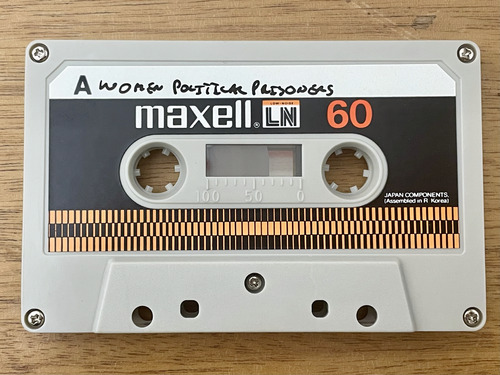
1st East Coast Conference on Women & Porn
Side B - 1st East Coast Conference on Women & Porn: “The following segment on the Velvet Sledgehammer features tapings from the 1st East Coast Conference on Women and Pornography.” -
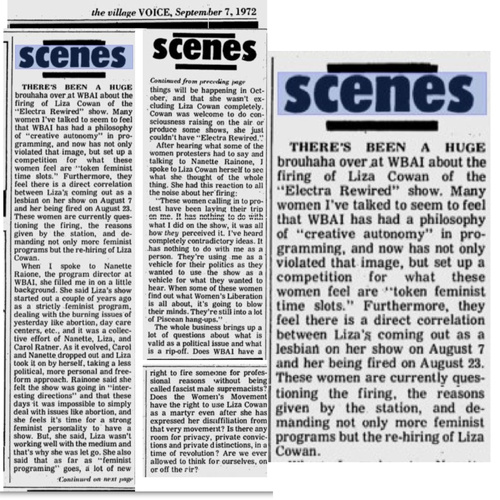
1972 Village Voice article courtesy of Liza Cowan
1972 Village Voice article courtesy of Liza Cowan -

-
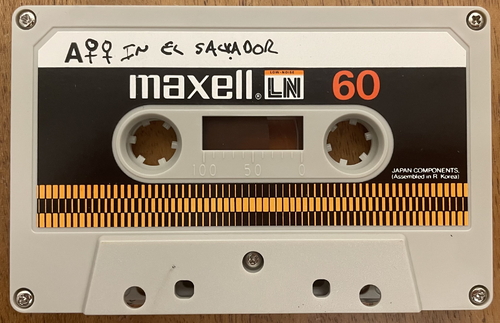
♀♀ (Women) in El Salvador
(This is Side A of tape) Part one of a program on Latin-American women, features a recorded lecture by journalist Anne Nelson given at an International Women's League for Peace and Freedom meeting. Nelson discusses her trip to El Salvador, the paramilitary death squads, and the specific state violence done to Salvadoran women. Nelson laments how this is not being reported on or considered "news" by fellow American reporters and Washington. -

A Lesbian Portrait (Lesbian Music For Lesbians Only) - Reel 2
A Lesbian Portrait consists of songs written by Linda Shear from 1972-1975. Shear, who requested that audiences for her performances be exclusively lesbian beginning in 1976, aimed to distribute A Lesbian Portrait through Lesbian-only networks. To support this goal, Shear and her then-partner Tryna Hope formed the distribution company Old Lady Blue Jeans. The album was released in 1977.
Read the liner notes.
2-1: Well Story – Spoken and Written by Tryna
2-2: Well Song
2-3: Old Woman
2-4: Song to Myself/Portrait
2-5: Family of Women
2-6: Lesbian Wombmoon-Chant -

A Lesbian Portrait (Lesbian Music For Lesbians Only) - Reel 1
A Lesbian Portrait consists of songs written by Linda Shear from 1972-1975. Shear, who requested that audiences for her performances be exclusively lesbian beginning in 1976, aimed to distribute A Lesbian Portrait through Lesbian-only networks. To support this goal, Shear and her then-partner Tryna Hope formed the distribution company Old Lady Blue Jeans. The album was released in 1977.
Read the liner notes.
1-1: Mama / Womanchild
1-2: Goddesses And Other Truths
1-3: Woman Let Go Now
1-4: For Tryna
1-5: Ninety
1-6: Remember -

-

“Becoming Visible: Survival for Black Lesbians”
1981 – The first conference in the eastern U.S. for Black Lesbians opens in Brooklyn, New York. It was called “Becoming Visible: Survival for Black Lesbians." -

"Poetry" radio program on WBAI hosted by Susan Howe, undated
Audre Lorde appears on Susan Howe's WBAI radio program "Poetry." She reads "Black Studies," "To My Daughter The Junkie On The Train," "To The Girl Who Lives In A Tree," "Song For A Thin Sister," "Oya," and "The Brown Menace" from her book New York Head Shop and Museum. On Side B, she reads newer poems including, "Solstice," "Dahomey," "Nobody Wants To Die On The Way," "School Note," and "Power." -

"Lesbians and Literature" panel discussion at MLA conference, 1977
Preceded by short presentation from representative of the recently vandalized Diana Press. Speakers, in order of appearance: moderator Julia Stanley (unnamed on tape); Mary Daly; Audre Lorde (11:38 into Side B); Judith McDaniel; Adrienne Rich. Lorde's speech is the original draft of her essay "The Transformation of Silence into Language and Action." -
