
Browse Items (4 total)
Sort by:
-
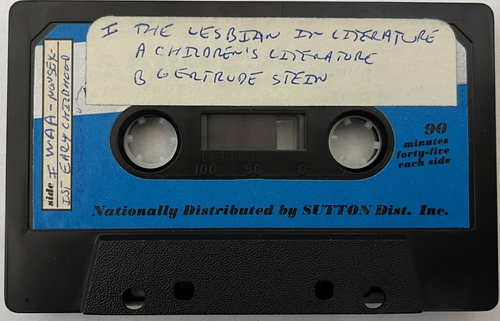
A: I The Lesbian in Literature A - Children's Literature B - Gertrude Stein / I WAA - NONSEX - 1st Early Childhood Curriculum;
B: II Gertrude Stein (Cont.)Recorded at the 1974 Gay Academic Union Conference at NYU, this panel, The Lesbian in Literature, features Janet Cooper and Cynthia Secor, chaired by Virginia Apuzzo. Cooper critiques the erasure of female affection, emotion, and intimacy in children’s literature, tracing it to the influence of early 20th-century librarian Anne Carroll Moore and her control over publishing standards that suppressed depictions of female relationships. Secor’s paper analyzes Gertrude Stein’s feminist and lesbian aesthetics, comparing her to James Joyce while celebrating Stein’s rejection of patriarchal literary traditions and her creation of new forms of expression rooted in female consciousness, identity, and language. Together, the talks explore censorship, literary history, and lesbian representation within both children’s and modernist literature. -

The Lesbian in Literature - Female Friendships, Crushes + Afffections in Children's Lit - Janet Cooper
This tape contains the third panel from the Gay Academic Union Conference at NYU, the "Lesbian in Literature" Panel. Panelists are Janet Cooper, speaking on female crushes and friendships in children's literature, and Cynthia Secor, speaking about Gertrude Stein and James Joyce. The moderator was Virginia Caputo.
Janet describes that the first room in a library targeted specifically for children was in the Pratt Library in Brooklyn in 1895. The librarian Anne Carole Moore worked there, and would become a very influential children's librarian. She speaks on the monopoly of children's literature in publishing and book awards, with Anne Carole Moore at the center due to her connections with other powerful librarians. Since Anne Carole Moore's appointment, child friendships and friend crushes in literature have disappeared. The removal of content in library books where children physically touched each other, Janet says, was a direct result of the fear of lesbianism.
Cynthia Secor speaks about Gertrude Stein and James Joyce. She asserts that Stein is an oft-overlooked figure in literature. Gertrude Stein was a sort of hidden figure, while James Joyce was taught everywhere. Stein was read by many lesbian women, but Cynthia did not read Stein until she joined the lesbian community. Cynthia reads a passage by Stein, "Cow come out...", discusses Stein's novella, Q.E.D., and her "Patriarchal Poetry" essay. -

Deborah Edel, Joan Nestle & Judith Schwarz Interview
Deborah Edel, Joan Nestle, and Judith Schwarz discuss the formation of the Lesbian Herstory Archives in the 1970s. They detail how the Archives grew out of a consciousness raising group through the Gay Academic Union in 1973. They talk about the mission of the archives, to ensure that lesbian voices and culture were heard and preserved. They also talk about the growth of their collections through donations of books, papers, and photographs from the lesbian community. -

Pamela Oline Interview, [date unknown]
Pamela Oline is interviewed. She is heterosexual and talks about her path to and experience of being a member of DOB and campaigning for gay and lesbian rights. She describes her childhood growing up in England, moving to America when she was 14 and changing career from a mathematician and to a psychotherapist. Recognizing the psychological issues of the time, she decided to understand the lesbian community from the inside. She talks about DOB meetings, lesbian and feminism issues, radical and conventional activism, marriage, and GAU (Gay Academic Union) meetings, panel discussions, etc.
Accompanied by an edited collection of clips, featuring Oline talking about being a Lesbian, the DOB and its eventual fractioning, and the debate of whether the lesbian's movement should be separate from the women's movement.